
Breast Lift
Many women wish to regain the youthful shape and contour of their breasts. Loss of skin elasticity, gravity, and other factors such as weight loss, pregnancy, and breastfeeding can ultimately change the shape and firmness of the breasts, leading to sagging and droopiness over time. Women often want to know what they can do to have a more “perky” and firm breast shape. When women consult with board-certified plastic surgeon Daniel C. Mills, MD, FACS about a breast lift—or mastopexy—they are generally looking to accomplish one of two things: replacing volume, or lifting drooping nipples (or a combination of both). The first goal, replacing volume that has diminished, can be achieved by implants via breast augmentation. If you fall into the second category, desiring to lift a drooping nipple area, you are likely a good candidate for a breast lift to enhance the shape and contour of your breasts.
- What is a Breast Lift?
- Breast Lift Candidates
- Degrees of Ptosis
- Breast Lift Consultation
- Breast Lift vs. Reduction
- Breast Lift Procedure
- Breast Lift Incisions
- GalaFlex® Scaffold
- Breast Lift Recovery
- Breast Lift Results
- Breast Lift Scars
- Breast Lift Cost
- Breast Lift Alternatives
- Breast Lift FAQ
Quick Facts About Breast Lift Procedures
- Sedation: General anesthesia
- Procedure Length: Generally less than 2 hours
- Potential Benefits: “Perkier,” more supported, more youthful-looking breasts
- Recovery: Everyday activities can usually be resumed after a week; patients can typically return to light exercise after 3 weeks; more strenuous exercise should be avoided for about 3-4 weeks
- Cost: $4,000–$20,000 (higher-end pricing may include implants)
What Is a Breast Lift?
Breast lift surgery is designed to reduce signs of ptosis (sagginess) by removing excess skin and tightening the remaining skin, ultimately bringing the breasts and nipples up to a more youthful position on the chest. Medically referred to as mastopexy, breast lift surgery can address an aesthetic concern that affects most women at some point in their lives: a drooping effect in the breasts that can lead to loss of shape and “perkiness.” This procedure allows Dr. Mills to give the breasts a more youthful and firm appearance, eliminating inelastic skin and reshaping the breasts for smoother, more vibrant results.
Who Is a Good Candidate for Breast Lift Surgery?
If your breasts are affected by sagging, inelastic skin that has altered their shape and created a drooping appearance, you may be an ideal candidate for breast lift surgery. This procedure is often beneficial for patients who have moderate to severe degrees of breast ptosis. During the initial consultation, Dr. Mills will evaluate your level of ptosis and talk with you about your options. Individuals who wish to rejuvenate breast contours and shape, diminish the size of the nipples and areolas, move the nipples to a more central area on the breasts, and/or lift the breasts to a more ideal location on the chest can typically benefit from this procedure. Good candidates for breast lift surgery must also be in good overall health and have reasonable expectations for the outcome. Dr. Mills will talk more with you about whether this procedure is right for your unique needs during the consultation.
What Are the Degrees of Breast Ptosis?
Using what is sometimes called the Regnault classification system,* Dr. Mills can measure the severity of your breast ptosis. The degrees, or “grades,” of ptosis are described below:
-
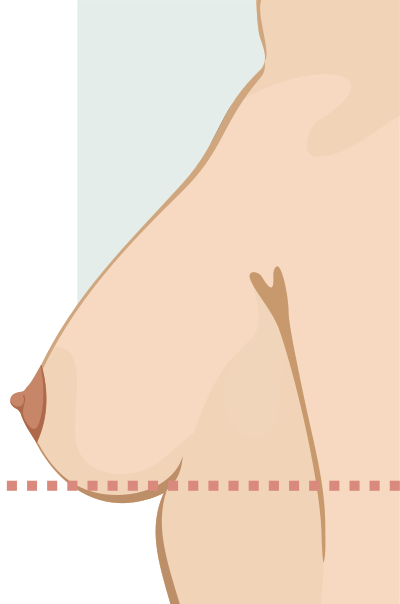 Pseudoptosis
 -
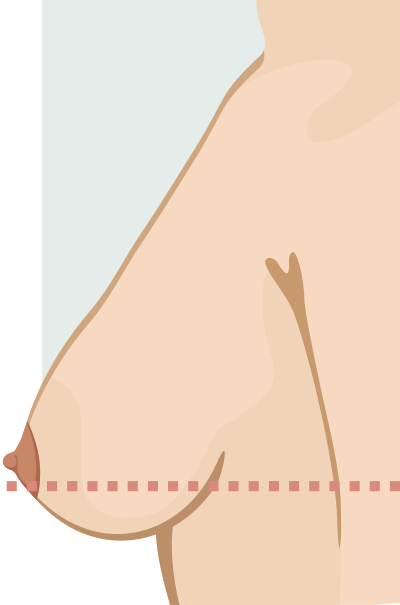 Grade I ptosis
 -
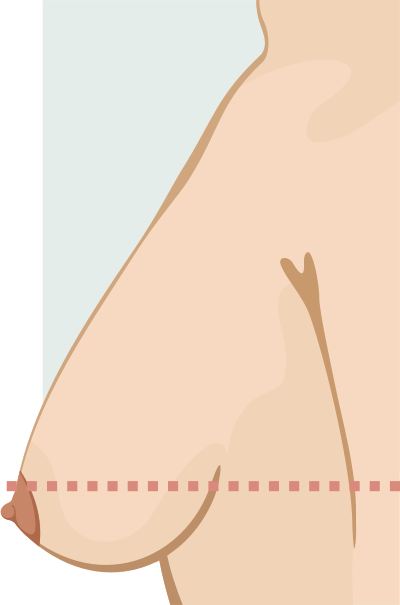 Grade II ptosis
 -
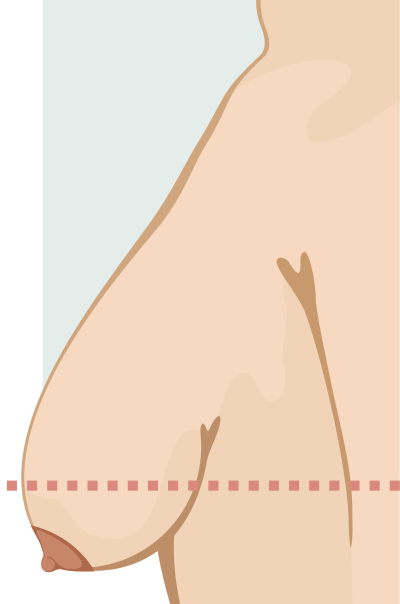 Grade III ptosis
-
Pseudoptosis, characterized by breasts that barely droop below the inframammary fold
-
Grade I ptosis, in which the breasts fall slightly below the inframammary fold and the nipples are level with the fold
-
Grade II ptosis, in which the breasts (and typically the nipples, as well) have descended moderately below the fold
-
Grade III ptosis, characterized by significant sagging below the fold, a pendulous appearance, and often downward-pointing nipples
Please note that these classifications are general guidelines, and degrees of breast ptosis can vary among individuals. Additionally, some people may have naturally different breast shapes and positions that do not fit precisely into these categories. In any case, Dr. Mills will work with you to develop a personalized plan for your aesthetic goals after a thorough examination of your breasts.
What Is the Breast Lift Consultation Like?
During your consultation and other preoperative visits, Dr. Mills will review your shape and personal goals. Two weeks prior to surgery, you will meet with our preoperative patient coordinator who will review all instructions with you and guide you through all of the necessary laboratory tests and health screenings. If you are a smoker, you will be advised to quit smoking at least four weeks prior to surgery and not to resume for at least two weeks after surgery. Additionally, you will be advised which medications (including hormones, aspirin, and ibuprofen), herbs, and supplements to cease taking from two weeks prior to surgery to two weeks after your surgery. This appointment will also be a time for you to ask any final questions. We want you to be physically and mentally ready for surgery, so that you have an optimal recovery period and great surgical results.
On your surgery day, you should allow approximately four to five hours for preoperative surgical admission, surgical time, and post-surgical recovery. During your surgery and recovery, you will be in the hands of our experienced surgical team, which includes Dr. Mills, a nurse anesthetist, a registered nurse, and a surgical technician. We ask that you have a responsible adult accompany you to and from the surgery center. This individual should be accessible by phone during your surgery and should be at our facility when you are ready for discharge. After your surgery, you will need to have someone care for you for the first 24 hours.
Breast Lift vs. Breast Reduction
While breast reduction surgery and mastopexy are frequently confused, the two procedures were developed to satisfy different goals. A breast lift is typically best suited for patients who want to achieve a more youthful and uplifted breast appearance, combat ptosis, and maintain or slightly augment their breast volume. On the other hand, a breast reduction aims to make the breasts smaller, not exclusively for cosmetic purposes but also to alleviate issues such as pain, physical limitations, or self-consciousness. In other words, the two procedures are not interchangeable; however, breast reduction surgery often involves a certain degree of reshaping (i.e. “lifting”) breast tissue, which may allow patients to experience benefits of both surgeries. Furthermore, if you are interested in combining your breast lift with breast reduction techniques, feel free to discuss this with Dr. Mills during your consultation.
How Is the Breast Lift Procedure Performed?
During your consultation, Dr. Mills will evaluate your case individually and suggest how to best meet your goals. If you are a good candidate for a breast lift, Dr. Mills will determine which approach would be best based upon how much your nipple needs to be lifted and how much upper pole fullness is needed.
He repositions the nipple-areolar complex higher and removes any excess skin, reshaping the breast’s contour. If a patient is additionally looking to add breast volume, Dr. Mills might also suggest placing breast implants. However, Dr. Mills usually prefers to place the implants in a staged manner with a second surgery to allow for better wound healing, safety and minimal scar appearance.
Breast lift surgery can help you achieve a shapelier, more feminine figure. View our before and after photo gallery to view our results. If you would like more information about the breast enhancement procedures we offer, please contact Aesthetic Plastic Surgical Institute today.
Where Are Incisions Placed During a Breast Lift?
Dr. Mills is proficient in various approaches to breast lift surgery, including:
- The standard technique. Also called the “inverted T” method, the standard technique is usually utilized to ease moderate to severe breast ptosis. This strategy employs three incisions: one circling the areola, one extending vertically down to the inframammary fold, and one within the crease.
- The “vertical” technique. The vertical, or “lollipop,” method involves an incision encircling the areola and then extending down to the breast crease.* It is often recommended for cases of mild to moderate ptosis.
- The “donut” technique. Sometimes referred to as a “Benelli lift,” the “donut” strategy is generally best suited for patients with smaller breasts or less significant ptosis. A single incision is made in a “donut” shape around the areola.
Dr. Mills will determine the best incisional method for your needs during your consultation. He welcomes any questions you may have about the procedure.
GalaFLEX® Scaffold for Soft Tissue Reinforcement
The recurrence of breast drooping is an issue that some women experience in the years following mastopexy. For these individuals, the lift achieved with surgery is often able to create an ideal appearance initially; however, weak and/or insufficient soft tissue in the breasts often fails to withstand the effects of gravity and various other factors, generally leading to breast re-sagging much sooner than anticipated.
For many women who show signs of weakened breast tissue and/or need soft tissue support at the time of breast lift surgery, Dr. Mills can utilize an advanced technique known as the GalaFLEX® scaffold to help prevent the recurrence of breast sagging after the mastopexy procedure. Made from a bioresorbable polymer that is completely compatible with the body, the GalaFLEX® scaffold is a surgical device that not only helps reinforce tissue areas requiring additional strength and support, but can also provide a lattice-like framework that encourages collagen to build and blood vessels to develop to form new, stronger tissue. Over the course of approximately 18–24 months, the bioresorbable scaffold will slowly and safely degrade through hydrolysis—the process of breaking a material down via water—leaving behind regenerated breast tissue that can be up to three to five times stronger than the original tissue.
In Dr. Mills’ experience, the GalaFLEX® scaffold has proved to be an excellent solution for combating the recurrence of breast drooping in many breast lift patients who need soft tissue reinforcement, ultimately helping to extend the results of their procedure.
What Is Recovery from Breast Lift Surgery Like?
You will have an office visit the day following your surgery, as well as several postoperative visits within the first week. Upon returning the day after surgery, Dr. Mills will remove your surgical dressing. You will be advised to wear a sports bra or bralette for three months to support the breasts while healing. After the initial postoperative visit, you will be able to shower fully.
Additionally, Dr. Mills recommends hyperbaric oxygen therapy starting the day after your surgery. He recommends five consecutive hyperbaric sessions. There are several hyperbaric treatment centers in the Orange County area for your convenience.
You will return to our office at one week, two weeks, and one month to remove sutures and to change the steri-strips. In the first couple of weeks, Dr. Mills will continue to monitor your progress and advise you in your postoperative regime and instructions. It is exceptionally important that you come to all recommended postoperative visits in order to minimize postoperative complications and achieve optimal results.
The most common complications associated with a mastopexy are bleeding, scarring, infection, asymmetries, changes in nipple or breast sensation (both temporary and permanent), and adverse reactions to anesthesia.
Dr. Mills looks forward to meeting with you in consultation to put together a custom surgical plan that best meets your needs. Should you have any questions in the meantime, please feel free to email our patient coordinator through our contact us page. We want to make sure that you are well informed about this and any other procedure. Dr. Mills wants this to be a great experience for you and we will do everything we can to serve your needs.
Mastopexy Recovery Timeline
You can expect:
- To drive after you are completely off your pain medications, which is usually about three to five days.
- To resume normal activities after about a week.
- To avoid strenuous and/or upper-body workouts for the first five to six weeks after surgery.
- To visit our office postoperatively at one day, one week, two weeks, one month, three months, six months, and one year. (We also recommend annual follow-up visits.)
- To perform monthly self-breast examinations.
- To see your final results at about 12 months, after your skin and tissues have relaxed and the scars subside.
What Are the Typical Results of Breast Lift Surgery?
Especially when the surgery is performed by a highly qualified provider, patients are usually ecstatic about their breast lift results. The procedure aims to create a more youthful, lifted, and aesthetically-pleasing breast appearance, and patients usually enjoy benefits such as improved position and enhanced shape. As with every procedure performed at Aesthetic Plastic Surgical Institute, your treatment plan will be customized to help create the physique you have always wanted.
Will I Have Obvious Breast Lift Scars?
Breast lift procedures will result in noticeable scarring; however, it is important to note that Dr. Mills has performed these procedures many times and utilizes advanced surgical skills that can minimize the appearance of breast lift scars. The type and location of the scars will ultimately depend on the specific mastopexy technique that will be used; Dr. Mills will discuss the available techniques with you during the initial consultation. It should also be noted that signs of scarring often dissipate to some degree over time, and our practice offers advanced treatments that can help reduce their appearance even further.
What Does a Breast Lift Cost?
Breast lift surgery is a custom-designed procedure; therefore, the total price of the treatment will be different for each patient. Factors such as the type and degree of surgery being performed (whether the treatment includes both breast lift and breast augmentation, or just one of those options) determine the total cost. Ultimately, your cost estimate will be informed by your unique needs and the nature of your cosmetic goals. Additional factors that will ultimately be taken into account include the complexity of the surgery, fees for anesthesiology and the surgical facility, whether breast implants were used in combination with mastopexy, and other components.
Dr. Mills is committed to providing our patients with an inclusive, up-front cost estimate of all associated expenses before they undergo breast lift surgery. Once your treatment plan is developed, a member of our team will calculate the total price of the surgery and present you with an estimate that takes all cost factors into account. We will be happy to discuss the many payment options we accept, and we can also talk with you about plastic surgery financing options if you are interested in paying for the procedure on a monthly basis.
Is a Non-Surgical Breast Lift Possible?
In general, it is not possible to achieve the same level of lifting and reshaping that surgical breast lift can provide with non-surgical methods. A surgical breast lift involves the removal of excess skin and repositioning of breast tissue, which cannot be replicated through non-surgical means. We advise you to be wary of any product or exercise routine that is alleged to produce effects similar to mastopexy; in reality, such a technique has yet to be discovered.
Additional Breast Lift FAQs
-
How much time should I take off of work?
While recovery time may vary, you should generally expect to take one week off for an administrative or desk-type job.
-
Can Dr. Mills do a breast lift and augmentation at the same time?
Dr. Mills usually prefers to do these surgeries at separate times to allow for better wound healing and minimize the appearance of scars. Recently he has been utilizing some new tools that can be used during surgery to allow him to do the placement of implants and a lift at the same time for some patients. He will be able to tell you when he examines you if you are a candidate for the combined procedures.
-
When can I work out again after surgery?
You can return to low impact aerobics beginning two weeks after surgery. You should not do higher impact aerobics for at least five to six weeks after surgery. Dr. Mills prefers that you wear a supportive bra while doing aerobic activity.
-
How long after my surgery can I go in a hot tub or pool?
When you immerse your scar into water, you lessen the tensile strength (e.g. natural skin strength), causing the scar to widen. With normal healing, the tensile strength of your skin returns to 70% after about three weeks and 90% by 8–10 weeks post-surgery. Dr. Mills discourages swimming or hot tubs for the first eight weeks after surgery. Other than getting in the shower, you should avoid any immersion in water during this time.
-
How long after my surgery can I sunbathe topless or go in a tanning bed?
You should stay out of the sun and artificial tanning lights for anywhere from 6–12 months (and maybe even longer). When premature scars are exposed to the sun (or tanning bed lights), they will tan at a different rate than the surrounding skin and become redder or darker. This pigment can become permanent, like a tattoo. You should keep your scars out of the sun until the scars are no longer red, indicating that the scar has matured. Again, this healing process typically takes anywhere from 6–12 months. Healing rates depend highly on skin thickness. The chest typically takes longer to heal, as the skin is thicker.
Schedule Your Consultation
We look forward to meeting you in consultation to develop a surgical plan that best suits your needs. Please contact our patient coordinator to schedule your one-one-one consultation. Dr. Mills wants this to be a great experience for you, and his staff will do everything we can to serve you.
Medical References*
World Journal of Surgical Oncology